Table of Contents
Industries need water of the right quality for manufacturing, cleaning, cooling, food processing, and other operations. However, raw water may contain suspended particles, dissolved salts, minerals, microorganisms, and other impurities. The treatment method depends on which contaminants need to be removed and how the treated water will be used.
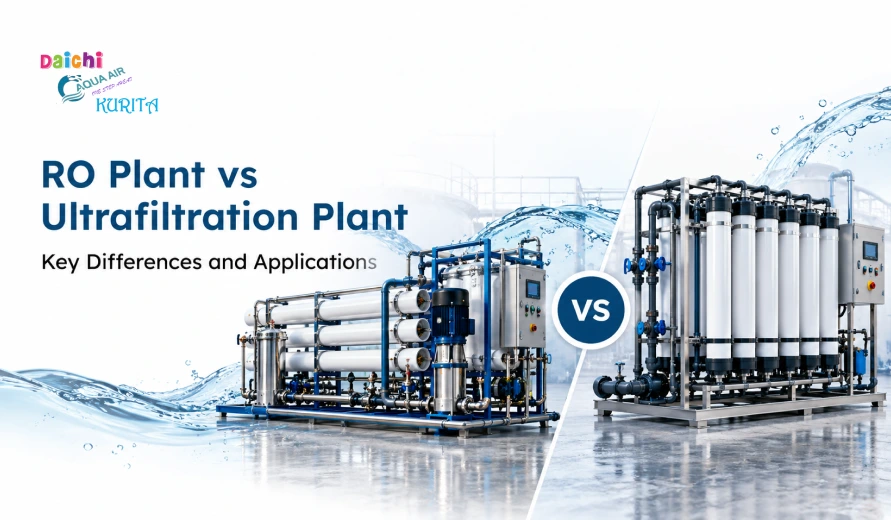
When comparing an RO Plant vs. an ultrafiltration plant, it is important to understand that these systems use different membrane technologies and serve different purposes. A reverse osmosis (RO) plant mainly reduces dissolved salts and other dissolved impurities, while an ultrafiltration (UF) plant primarily removes suspended solids, colloids, and many microorganisms.
Both technologies play an important role in industrial water treatment. In some applications, they can also work together to produce water that meets specific quality requirements.
What Is a Reverse Osmosis (RO) Plant?
A reverse osmosis plant is a water purification system that uses a semi-permeable membrane to separate dissolved substances from water. The system applies pressure to move water through the membrane while retaining a large proportion of dissolved salts and other contaminants.
An industrial RO plant is commonly used when a process requires water with lower total dissolved solids (TDS). The exact quality of the treated water depends on the incoming water, membrane selection, system design, and operating conditions.
How Does an RO Plant Work?
The reverse osmosis process generally includes these stages:
- Pre-treatment: Raw water passes through suitable filtration or other treatment stages to reduce suspended particles and protect the RO membranes.
- Pressure application: A high-pressure pump pushes the water towards the RO membranes.
- Membrane separation: Water passes through the membrane, while a large proportion of dissolved salts and other impurities remains in the concentrated stream.
- Water collection: The treated water, known as permeate, is collected for use or further treatment.
- Concentrate management: The rejected stream contains concentrated impurities and must be managed according to the system design and applicable requirements.
RO is useful when reducing dissolved salts is a major treatment objective. However, the plant must be designed based on feed-water quality and required output.
What Is an Ultrafiltration (UF) Plant?
An ultrafiltration plant uses a membrane with very small pores to separate suspended particles, colloids, and many microorganisms from water. It is commonly used to improve water clarity and reduce the load on downstream treatment equipment.
Unlike reverse osmosis, ultrafiltration generally does not remove dissolved salts to a significant extent. Minerals that remain dissolved in water can pass through the UF membrane, depending on the membrane and operating conditions.
An ultrafiltration plant may be used as a standalone filtration stage or as pre-treatment before an RO plant.
How Does an Ultrafiltration Plant Work?
The process usually involves the following steps:
- Water intake: Raw water enters the UF system after any necessary preliminary treatment.
- Membrane filtration: Water passes through membranes with microscopic pores.
- Particle separation: The membrane retains suspended solids, colloids, and many microorganisms.
- Filtered water collection: The water passing through the membrane is collected for further use or treatment.
- Membrane cleaning: Backwashing or other cleaning methods may be used according to the system design to control the buildup of retained material.
UF can be particularly useful when the main concern is suspended contamination rather than dissolved salts.
RO Plant vs Ultrafiltration Plant: Key Differences
Although both systems use membranes, their treatment objectives are different.
| Comparison factor | RO Plant | Ultrafiltration Plant |
| Main purpose | Reduces dissolved salts and many dissolved impurities | Removes suspended solids, colloids, and many microorganisms |
| Membrane type | Reverse osmosis membrane | Ultrafiltration membrane |
| Dissolved salts | Removes a large proportion of dissolved salts | Generally allows dissolved salts to pass through |
| Suspended particles | Usually requires suitable pre-treatment to protect membranes | Directly targets suspended particles and colloids |
| Operating pressure | Generally higher pressure is required | Generally lower pressure than RO |
| Water output | Lower-TDS water suitable for applications requiring dissolved-solids reduction | Filtered water with reduced suspended contamination |
| Common role | Purification and reduction of dissolved substances | Filtration and pre-treatment |
| Waste stream | Produces a concentrate stream | May produce a backwash or cleaning waste stream |
| Typical application | Process water, boiler feed pre-treatment, and applications requiring reduced dissolved salts | Raw-water filtration, water clarification, and RO pre-treatment |
The table provides a general comparison. Actual performance depends on water quality, membrane specifications, plant design, and operating conditions.
Which Contaminants Can RO and UF Remove?
Understanding the type of contamination in the incoming water is one of the most important steps in choosing a water treatment plant.
Contaminants Targeted by RO
Reverse osmosis is designed to reduce dissolved salts, many dissolved ions, and certain other contaminants. Its performance depends on the membrane, pressure, water chemistry, and operating conditions.
Industries may consider RO when they need to:
- Reduce TDS and salinity.
- Lower the concentration of certain dissolved minerals.
- Produce process water with controlled dissolved-solids levels.
- Provide additional purification after pre-treatment.
- Meet specific water quality requirements for manufacturing or other industrial uses.
RO is not a substitute for every type of treatment. Depending on the source water, additional processes may be needed to manage organic compounds, gases, microorganisms, or other contaminants.
Contaminants Targeted by UF
Ultrafiltration mainly targets material that is larger than the membrane’s effective separation range. This commonly includes suspended solids, colloidal particles, and many microorganisms.
UF may be useful for:
- Reducing turbidity caused by suspended particles.
- Improving water clarity.
- Removing many bacteria and other microorganisms, depending on membrane performance and system integrity.
- Reducing the particle load entering an RO plant.
- Supporting filtration in industrial and commercial water treatment systems.
UF does not generally remove dissolved salts, and it should not be assumed to remove every virus or dissolved chemical. Where microbial safety is important, the full treatment system and its performance must be assessed.
Industrial Applications of RO Plants
RO plants are used in industries where dissolved-solids reduction is important. The required water quality varies according to the production process.
Pharmaceutical Industry
Pharmaceutical facilities may need water that meets specific quality requirements for production, cleaning, or utilities. RO may form one stage of a wider purification system, with additional treatment and monitoring selected according to the application.
Food and Beverage Processing
Water quality can affect product consistency, taste, equipment performance, and cleaning operations. RO may be used where lower dissolved mineral content is required. The final treatment setup depends on the type of product and applicable quality standards.
Power Plants and Boiler Systems
Certain boiler applications require water with controlled dissolved mineral levels to reduce scaling and related operating problems. RO may be included in the treatment process, often alongside other technologies such as demineralisation.
Manufacturing and Chemical Processing
Manufacturing and chemical facilities use water for production, cleaning, and utilities. An RO plant may be suitable where dissolved salts or specific dissolved impurities need to be reduced before the water enters the process.
Industrial Applications of Ultrafiltration Plants
UF plants are useful in applications where removing suspended contamination and improving water clarity are key objectives.
Raw Water Treatment
Surface water and other sources may contain suspended particles, colloids, and microorganisms. UF can help reduce these contaminants before the water moves into further treatment stages.
RO Pre-Treatment
One of the important uses of UF is protecting downstream RO membranes from excessive suspended particles. Better pre-treatment can help reduce fouling risks, although the system still requires suitable operation, monitoring, and maintenance.
Food and Beverage Processing
Some food and beverage processes require water with low turbidity and controlled particulate content. UF may be used where its filtration performance matches the process requirements. Additional treatment may be needed for dissolved substances or specific safety requirements.
Commercial and Institutional Facilities
Hospitals, commercial buildings, and other facilities may use UF as part of a wider water treatment system. The selection depends on the source water, expected water demand, and required treated-water quality.
Can RO and Ultrafiltration Work Together?
Yes. RO and UF can be combined when the incoming water contains both suspended contaminants and dissolved impurities that need to be reduced.
For example, a treatment setup may use UF to remove suspended particles and colloids before the water enters the RO stage. The RO membrane can then reduce dissolved salts and other impurities.
A simplified treatment sequence may look like this:
Raw water → Preliminary filtration → Ultrafiltration → Reverse osmosis → Additional treatment, if required
This is only an example. Some facilities may require different pre-treatment stages, while others may not need UF at all. Water analysis should determine the appropriate sequence.
Using UF before RO can help manage suspended contamination, but it does not remove the need to monitor RO feed-water chemistry, membrane performance, and operating conditions.
How to Choose Between an RO Plant and an Ultrafiltration Plant
The right choice depends on the water source, the contaminants present, and the quality required at the end of the treatment process.
1. Test the Incoming Water
Start by checking the source water for TDS, turbidity, hardness, suspended solids, and other relevant parameters. Additional tests may be needed depending on the source and intended use.
Water analysis helps identify whether the main concern is dissolved contamination, suspended particles, or both.
2. Define the Required Water Quality
Different uses require different industrial water system quality. A process that needs lower dissolved salts may require RO, while a process that mainly needs lower turbidity may benefit from UF.
The system should be selected according to the actual quality requirements rather than choosing a technology based only on capacity.
3. Check Daily Water Demand
Estimate the amount of water required per day and the expected operating hours. The plant must be sized to meet demand while accounting for process requirements, maintenance, and the output characteristics of the selected technology.
4. Consider Operating and Maintenance Needs
Both systems need regular inspection and maintenance. RO plants require monitoring of pressure, permeate quality, concentrate flow, and membrane performance. UF plants may need backwashing, cleaning, and checks for membrane fouling or damage.
Energy use, cleaning requirements, consumables, and waste-stream management should be considered when comparing the overall operating cost.
5. Review the Complete Treatment Process
A single technology may not address every contaminant in the water. Depending on the test results, a treatment setup may include sand filtration, activated carbon filtration, softening, UF, RO, demineralisation, or disinfection.
For this reason, it is better to evaluate the full treatment requirement before selecting a plant.
RO and Ultrafiltration Solutions for Industrial Water Treatment
Choosing the right membrane technology is an important part of designing an effective water treatment system. RO is useful where dissolved salts need to be reduced, while UF is mainly used to remove suspended particles and colloids. When the source water contains both types of contamination, the two systems may work together.
Daichi Kurita Aqua-Air offers industrial water treatment solutions, including RO Plants and Ultrafiltration Plants. These systems can be considered according to the water source, treatment capacity, and intended application.
Before selecting a system, businesses should review their water analysis, process requirements, operating conditions, and treated-water quality targets. This helps identify a suitable treatment approach rather than relying on a general solution for every facility.
Conclusion
The main difference between an RO Plant vs Ultrafiltration Plant is the type of contamination each technology is designed to address. RO reduces dissolved salts and many dissolved impurities, while UF mainly removes suspended particles, colloids, and many microorganisms.
Neither technology is automatically better in every situation. The correct choice depends on the incoming water quality and the requirements of the final application. In some industrial facilities, UF provides useful pre-treatment for RO, allowing each technology to perform its specific role.
A water analysis and a clear understanding of the required output quality can help businesses select a suitable system and plan for reliable long-term operation.
Frequently Asked Questions
What is the main difference between an RO Plant and an Ultrafiltration Plant?
An RO plant reduces dissolved salts and many dissolved impurities using a semi-permeable membrane. An ultrafiltration plant mainly removes suspended solids, colloids, and many microorganisms. UF generally does not significantly reduce TDS.
Which is better for industrial water treatment, RO or UF?
Neither is universally better. RO is suitable when dissolved-solids reduction is required, while UF is useful for removing suspended particles and improving water clarity. The choice depends on the incoming water and the required output quality.
Can an ultrafiltration plant remove dissolved salts?
No, not to a significant extent under normal operating conditions. UF membranes are designed mainly to separate suspended particles, colloids, and many microorganisms. Reverse osmosis is generally used when dissolved salts need to be reduced.
Is ultrafiltration required before an RO plant?
Not in every case. UF may be used before RO when the incoming water contains suspended particles or colloids that need to be reduced. Other pre-treatment methods may be more suitable in some applications. Water analysis should guide the decision.
Which industries use RO and ultrafiltration plants?
Both technologies are used in sectors such as pharmaceuticals, food and beverage processing, manufacturing, and commercial facilities. RO is often selected when dissolved-solids reduction is needed, while UF is used for filtration and as pre-treatment in suitable applications.