Table of Contents
Industries use water for manufacturing, cleaning, cooling, boilers, and many other operations. The amount of water required depends on the type of industry, production schedule, and quality needed for each process. When water contains high levels of dissolved salts and other impurities, an industrial reverse osmosis system may be used to produce water that meets specific process requirements.
Choosing the right Industrial RO plant capacity matters because the plant must supply enough treated water to meet daily demand. A system that is too small may struggle to meet production needs, while an oversized system may increase equipment and operating costs unnecessarily.
Before selecting an industrial RO plant, businesses should understand their daily water demand, feed-water quality, operating hours, recovery rate, and required treated-water quality. This guide explains these factors in simple terms.
What Is Industrial RO Plant Capacity?
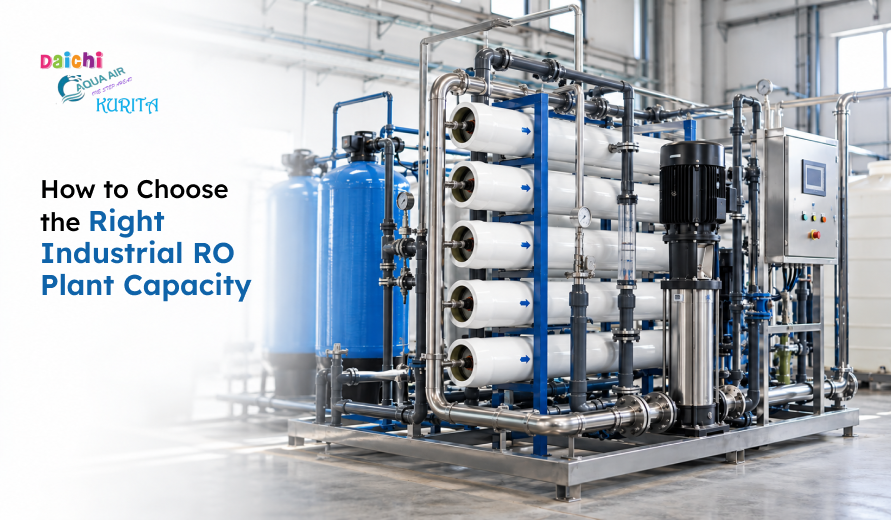
Industrial RO plant capacity refers to the amount of treated water a reverse osmosis plant can produce within a specified period. It is commonly expressed in litres per hour (LPH), litres per day (LPD), or cubic metres per day.
For example, a plant rated at 1,000 litres per hour is designed to produce 1,000 litres of treated water per hour under its specified operating conditions. Actual output can vary with feed-water temperature, water quality, membrane condition, pressure, and system design.
An industrial RO plant uses a semi-permeable membrane to reduce dissolved salts and many other impurities. Water passes through the membrane under pressure, producing treated water called permeate. The remaining stream contains concentrated impurities and is known as concentrate or reject water.
Understanding the difference between feed water and treated-water output is essential when calculating the required RO plant capacity.
Why Is Correct RO Plant Capacity Important?
The correct capacity helps a business plan its water supply according to actual operating needs. Capacity selection also affects installation, operation, and maintenance.
1. Meets Daily Water Demand
A properly sized plant can supply the treated water required for production, cleaning, utilities, and other applications. This helps reduce the risk of water shortages during operating hours.
2. Supports Consistent Production
Some industrial processes require a steady supply of water with controlled dissolved-solids levels. If the RO plant cannot meet the required flow, the facility may need storage tanks, adjusted operating schedules, or additional treatment capacity.
3. Helps Manage Operating Costs
An oversized plant can involve higher initial equipment costs and may not operate as efficiently if the system is poorly matched to demand. An undersized plant may require extended operating hours or additional equipment.
Selecting the right capacity helps balance production needs with practical operating costs.
4. Supports Better Water Management
RO plants produce a treated-water stream and a concentrate stream. Understanding the expected output and reject volume helps businesses plan water supply, storage, and concentrate management.
Step 1: Calculate the Daily Water Requirement
The first step in RO plant sizing is to estimate how much treated water the facility needs each day.
Consider all applications that will use RO water, such as:
- Manufacturing and processing
- Boiler feed-water pre-treatment
- Equipment and product cleaning
- Laboratory or process requirements
- Other approved industrial uses
Suppose a manufacturing facility requires 20,000 litres of RO-treated water per day. This is the daily permeate requirement, not the amount of raw water entering the plant.
The business should also check whether demand remains steady throughout the day or increases during particular production periods.
A simple calculation is:
Daily treated-water requirement = Total expected RO water use per day
If several processes use RO water, add their individual requirements and account for any expected peak demand or planned expansion.
Step 2: Consider the Plant’s Operating Hours
The daily water requirement helps determine the hourly production capacity needed.
For example, if a facility requires 20,000 litres of treated water per day and plans to operate the RO plant for 10 hours, the basic hourly output requirement is:
Required hourly output = Daily water demand ÷ Operating hours
20,000 ÷ 10 = 2,000 litres per hour.
In this example, the plant needs to supply approximately 2,000 LPH of treated water during those 10 operating hours.
This is a starting estimate rather than a final equipment specification. The design should also account for actual membrane performance, downtime, peak demand, storage arrangements, and the quality of the incoming water.
Step 3: Understand the RO Plant Recovery Rate
The recovery rate indicates how much of the incoming feed water becomes treated water. The remaining water leaves as concentrate.
For example, if a system has a recovery rate of 50%, approximately half of the feed water becomes permeate, while the remainder leaves as concentrate. Actual recovery depends on the water chemistry, membrane design, pressure, and operating limits.
The following formula helps estimate feed-water requirements:
Feed-water requirement = Required treated-water output ÷ Recovery rate
If the required output is 20,000 litres per day and the assumed recovery rate is 50%, the estimated feed-water requirement is:
20,000 ÷ 0.50 = 40,000 litres per day.
This means approximately 40,000 litres of feed water would be required to produce 20,000 litres of treated water at that recovery rate.
This is a simplified example. A suitable recovery rate must be established from the feed-water analysis and system design. It should not be increased without checking scaling, fouling, and concentrate-management risks.
Step 4: Check the Feed-Water Quality
Incoming water quality directly affects RO system design and performance. Groundwater, surface water, and municipal supplies can have different levels of dissolved salts, hardness, suspended solids, and other contaminants.
Before selecting an Industrial RO Plant, the water should be tested for relevant parameters, which may include:
- Total dissolved solids (TDS)
- Hardness
- pH
- Turbidity and suspended solids
- Iron and manganese
- Silica and other scale-forming substances
- Other contaminants relevant to the source and application
High hardness, suspended solids, and certain dissolved substances may require suitable pre-treatment to protect the RO membranes.
For example, filtration can reduce suspended particles, while a water softening system may be considered when hardness needs to be controlled. The required pre-treatment depends on the full water analysis rather than one parameter alone.
Feed-water quality also affects the pressure required, expected permeate flow, recovery rate, cleaning frequency, and membrane service life.
Step 5: Identify the Required Treated-Water Quality
Not every industrial process requires the same water quality. Some applications mainly need a reduction in dissolved salts, while others have tighter limits for specific minerals or contaminants.
Before choosing an RO plant, determine:
- The required TDS or conductivity range
- Any limits on particular dissolved substances
- Whether further purification is necessary
- The quality requirements of the production process
- Whether the water will be used directly or treated again
In some applications, RO may be followed by additional processes such as demineralisation or other polishing treatment. The complete treatment setup should be based on the intended use of the water.
Step 6: Account for Peak Demand and Storage
Daily water demand may not reflect the highest amount of water needed at one time. For example, a facility may use large volumes of treated water during cleaning or a particular production stage.
Businesses should review hourly demand, production schedules, and available storage tanks before finalising RO plant sizing.
A treated-water storage tank can help balance differences between production and consumption. However, tank capacity, water quality, storage time, and hygiene requirements must also be considered.
If demand changes significantly during the day, the plant capacity should be selected to work with the facility’s actual water-use pattern rather than relying only on the daily average.
Step 7: Consider Energy, Maintenance, and Future Expansion
An industrial reverse osmosis plant needs pumps, membranes, controls, and other components to operate. Its energy consumption and maintenance requirements depend on the design and operating conditions.
When comparing systems, consider:
Energy requirements: Feed-water quality, operating pressure, and system design affect power consumption.
Membrane maintenance: Membranes need regular performance checks and cleaning when required. The frequency depends on feed-water conditions and operating practices.
Pre-treatment: Filters, softeners, and other treatment stages need suitable maintenance to protect downstream equipment.
Plant availability: Allow for planned cleaning and maintenance when estimating how many operating hours are available for water production.
Future demand: If production is expected to increase, consider the likely additional water requirement during the initial planning stage.
These factors help businesses choose a system that suits both current operations and reasonable future needs.
Common Mistakes to Avoid When Selecting RO Plant Capacity
Some capacity-selection mistakes can lead to supply problems or higher operating costs.
- Using only the daily water figure: Hourly demand and peak usage also matter.
- Ignoring recovery rate: The raw-water requirement is greater than the treated-water output.
- Skipping water analysis: Feed-water quality affects membrane selection, pre-treatment, and performance.
- Assuming rated output is always available: Actual production can change with water temperature, pressure, fouling, and membrane condition.
- Overlooking reject-water management: The concentrate stream must be handled appropriately.
- Choosing capacity based only on the purchase price: Operating hours, maintenance, energy use, and future requirements should also be reviewed.
A capacity estimate is useful for initial planning, but the final system design should be based on water analysis and the required operating conditions.
Industrial RO Plant Solutions for Different Water Requirements
Industrial facilities need different RO capacities depending on their production processes, water consumption, and incoming water quality. A suitable system should be selected after assessing the amount of water required, the operating schedule, the feed-water characteristics, and the desired treated-water quality.
Daichi Kurita Aqua-Air provides industrial water treatment solutions, including RO plants for applications that require dissolved-solids reduction. Businesses can review the Water Treatment page to learn about the available treatment solutions.
Before selecting a plant, prepare the daily water demand, expected operating hours, feed-water test results, required permeate quality, and any planned increase in production. These details help establish a realistic capacity requirement and guide the design of the complete treatment system.
Conclusion
Choosing the right Industrial RO Plant Capacity begins with understanding how much treated water a facility needs and when it needs it. Daily demand, operating hours, recovery rate, feed-water quality, and the required treated-water quality all influence the final selection.
Businesses should also consider storage, energy use, membrane maintenance, pre-treatment, and concentrate management. A simple capacity calculation provides a useful starting point, but the final specification should be confirmed through water analysis and appropriate system design.
With careful planning, industries can select an RO plant that meets their water requirements and supports reliable day-to-day operations.