Table of Contents
Industries, commercial facilities, offices, hospitals, and other large sites generate different types of wastewater every day. This wastewater cannot always be treated in the same way because its contents depend on where it comes from and what activities produced it. Understanding the difference between an Effluent Treatment Plant and a Sewage Treatment Plant helps businesses select a treatment system that matches their actual wastewater needs.
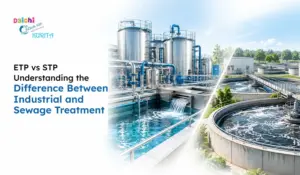
An ETP Plant is mainly designed to treat industrial effluent generated during manufacturing and processing activities. An STP Plant, on the other hand, is used to treat sewage and domestic wastewater from sources such as toilets, kitchens, bathrooms, and other domestic facilities.
Both systems are important parts of modern wastewater management, but their purpose, treatment requirements, and applications are different.
What Is an Effluent Treatment Plant?
An Effluent Treatment Plant (ETP) is a treatment system designed to manage wastewater produced by industrial processes. The wastewater generated by a factory can contain suspended solids, oils, chemicals, organic matter, colour, and other contaminants depending on the type of industry.
For example, wastewater from a textile unit may have dyes and chemicals, while food-processing wastewater may contain organic matter, grease, and suspended solids. Chemical and pharmaceutical industries can generate wastewater with different chemical characteristics.
This is why an ETP is generally planned according to the type of industrial effluent, its flow rate, pollutant levels, and the required treated-water quality.
A properly designed Industrial Wastewater Treatment Plant may use several treatment stages to reduce different types of contaminants before discharge or further treatment.
What Is a Sewage Treatment Plant?
A Sewage Treatment Plant (STP) is designed to treat sewage or domestic wastewater. This type of wastewater mainly comes from toilets, bathrooms, kitchens, offices, residential areas, and similar facilities.
An STP Plant generally focuses on removing organic matter, suspended solids, and other pollutants commonly found in domestic sewage. Biological treatment is often an important part of the process because microorganisms can help break down biodegradable organic matter.
Industries may also need an STP when their facilities have offices, worker accommodations, canteens, or other areas that generate domestic sewage.
The treated water may be considered for suitable non-potable applications when it meets the required quality standards and the facility has an appropriate reuse system.
ETP vs STP Key Difference
The main difference between ETP and STP is the source and nature of the wastewater they are designed to treat.
| Factor | ETP | STP |
| Full form | Effluent Treatment Plant | Sewage Treatment Plant |
| Main purpose | Treatment of industrial effluent | Treatment of domestic sewage |
| Wastewater source | Manufacturing and industrial processes | Toilets, bathrooms, kitchens and domestic areas |
| Typical contaminants | Chemicals, oils, process waste, suspended solids and organic matter | Organic matter, suspended solids and domestic waste |
| Treatment design | Depends heavily on the industry and effluent characteristics | Generally based on sewage characteristics and flow |
| Common applications | Textile, chemical, pharmaceutical, food, manufacturing and other industries | Offices, residential facilities, hospitals, campuses and industrial sites |
The two systems can sometimes exist at the same facility because an industrial site may generate both process wastewater and domestic sewage.
How Does an ETP Plant Work?
The treatment process in an ETP depends on the characteristics of the industrial wastewater. There is no single treatment sequence that works for every industry.
A typical Effluent Treatment Plant may include stages such as:
- Screening and preliminary treatment
- Equalisation
- Oil and grease removal
- Chemical coagulation
- Biological treatment
- Clarification
- Filtration
- Disinfection
- Sludge management
The exact combination depends on the pollutants present in the wastewater and the quality required after treatment.
For some applications, additional technologies such as membrane filtration, reverse osmosis, evaporation, or water-recovery systems may be considered. The treatment system should therefore be selected after studying the wastewater characteristics rather than choosing equipment based only on plant capacity.
How Does an STP Plant Work?
A Sewage Treatment Plant normally uses a combination of physical and biological processes to treat domestic wastewater.
The initial stage may remove larger solids and unwanted materials. After that, biological treatment can reduce biodegradable organic matter. Clarification and filtration can then help improve the quality of treated water.
Depending on the application, disinfection may also be included before the treated water is reused or discharged.
The actual treatment process can vary according to sewage quantity, site conditions, required treated-water quality, and the intended reuse application.
Why Industrial Wastewater Treatment Needs a Different Approach
Industrial wastewater is not the same from one factory to another. The wastewater from a food-processing facility can be very different from wastewater generated by a textile, chemical, pharmaceutical, or automotive unit.
This makes Industrial Wastewater Treatment more application-specific.
Before selecting an Industrial Wastewater Treatment Plant, businesses should consider:
- Type of industry
- Wastewater source
- Daily wastewater flow
- Pollutant concentration
- Chemical characteristics
- Available space
- Required treated-water quality
- Discharge or reuse requirements
Testing the wastewater can help identify the treatment processes required. It can also prevent the installation of unnecessary treatment stages or equipment that does not match the actual wastewater.
Can an Industry Need Both ETP and STP?
Yes. An industrial facility can generate both industrial effluent and domestic sewage.
For example, wastewater from production, processing, cleaning, or manufacturing activities may need an ETP. At the same time, sewage generated by toilets, offices, kitchens, or staff facilities may require an STP.
In such cases, the two streams can be managed separately according to their characteristics. Treating each wastewater stream through the appropriate system can make the overall Wastewater Treatment Plant more suitable for the facility’s requirements.
ETP, STP and Other Water Treatment Systems
ETP and STP are not the only treatment systems used in industrial water management. Depending on the water source and treatment objective, industries may also require technologies such as reverse osmosis, ultrafiltration, demineralisation, or other filtration systems.
For example, an ETP may treat industrial wastewater, while RO or UF can provide additional purification when treated water needs to meet a particular quality requirement.
This is why Industrial Water Treatment should be planned as a complete process rather than focusing on one piece of equipment.
A suitable Industrial Effluent Treatment setup can also be connected with water-reuse practices where the treated water is appropriate for selected applications.
Choosing the Right Wastewater Treatment System
The right treatment system depends on what type of wastewater a facility generates.
If the main concern is wastewater from an industrial process, an ETP may be required. If the wastewater comes primarily from domestic activities, an STP may be appropriate. Facilities generating both types may need separate treatment arrangements.
The choice should consider wastewater testing, flow rate, pollutant levels, treatment objectives, space, operation requirements, and future changes in production.
A properly planned Sewage Treatment System or industrial treatment setup can help a facility manage wastewater more systematically while supporting water reuse and responsible water management.
Final Thoughts
The difference between ETP and STP mainly comes down to the source and characteristics of wastewater. An Effluent Treatment Plant is designed for industrial effluent, while a Sewage Treatment Plant is designed for domestic sewage.
Neither system should be selected simply because it has a particular capacity or treatment technology. The wastewater characteristics, required treatment quality, site conditions, and intended use of treated water should guide the selection.
For industries, a complete approach may include an ETP along with other Wastewater Treatment Plant technologies such as RO, ultrafiltration, or water-recovery systems. With proper planning, businesses can manage wastewater more effectively and make better use of available water resources.
Frequently Asked Questions
What is the main difference between ETP and STP?
An ETP is mainly used to treat industrial effluent generated by manufacturing and processing activities. An STP is used to treat sewage or domestic wastewater generated by toilets, bathrooms, kitchens, offices, residential areas, and similar sources.
What is an ETP Plant used for?
An ETP Plant is used to treat industrial wastewater containing pollutants such as suspended solids, oils, chemicals, organic matter, and other process-related contaminants. The treatment process depends on the type of industry and the characteristics of its wastewater.
What is an STP Plant used for?
An STP Plant treats domestic sewage. It commonly uses physical and biological treatment processes to reduce suspended solids and biodegradable organic matter before the treated water is discharged or considered for suitable reuse.
Can an industrial facility use both ETP and STP?
Yes. An industrial facility can have both systems when it generates industrial effluent from production processes as well as domestic sewage from toilets, offices, kitchens, or other staff facilities.
How do I choose between an ETP and STP?
The choice depends mainly on the source and characteristics of the wastewater. Industrial process wastewater generally requires an ETP, while domestic sewage requires an STP. Wastewater testing, flow rate, pollutant levels, required treated-water quality, and reuse or discharge requirements should also be considered before selecting a system.