Table of Contents
Maintaining good air quality, temperature, and humidity is important in many industrial and commercial facilities. Pharmaceutical plants, textile units, food processing facilities, hospitals, offices, and warehouses may all need equipment to control indoor air conditions. Two systems commonly used for air treatment are an Air Handling Unit (AHU) and an Air Washer.
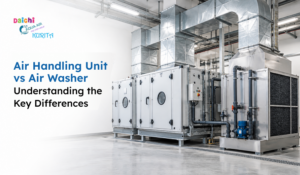
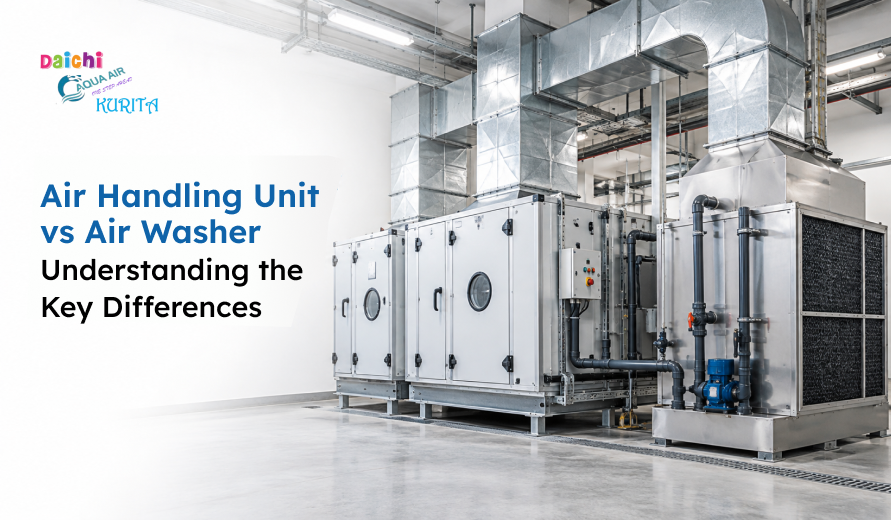
Although both systems help improve indoor air conditions, they work differently and serve different purposes. An Air Handling Unit vs Air Washer comparison helps businesses understand which system may suit their facility, production process, and air quality requirements.
An air handling unit with AC is mainly used to filter, cool, condition, and distribute air through a building. An air washer uses water to cool and humidify air while removing some dust and airborne particles. The right choice depends on the required temperature, humidity, filtration level, and operating conditions.
What Is an Air Handling Unit?
An Air Handling Unit is a system that conditions and circulates air inside a building or industrial facility. It receives fresh air, return air, or a mixture of both, treats it, and supplies it to different areas through ducts.
An Air Handling Unit with AC combines air handling and cooling in one system. It can include filters, fans, cooling coils, dampers, and controls, depending on the application.
The system helps maintain suitable indoor conditions by managing airflow, temperature, and air cleanliness. Humidity can also be controlled when the unit has the required components and control features.
How Does an Air Handling Unit Work?
An air handling unit generally follows these steps:
- Air intake: Fresh air or return air enters the unit.
- Filtration: Pre-filters and fine filters help remove dust and airborne particles.
- Cooling or conditioning: Air passes over a cooling coil to reduce its temperature. Other components may be included if heating or additional conditioning is required.
- Air circulation: A fan moves the treated air through the duct system.
- Air distribution: Conditioned air reaches the required rooms, production areas, or workspaces.
The exact arrangement depends on the facility’s needs. For example, a pharmaceutical plant may require stricter air control than a general commercial office.
Common Applications of Air Handling Units
Air handling units are used in places where temperature, airflow, and air cleanliness need to be managed. Common applications include:
- Pharmaceutical manufacturing facilities
- Hospitals and healthcare buildings
- Laboratories and cleanrooms
- Food processing units
- Commercial buildings and offices
- Hotels and hospitality facilities
- Industrial production areas
An AHU can support consistent indoor conditions, protect sensitive equipment, and help maintain suitable environments for people and production activities.
What Is an Air Washer?
An Air Washer is an air treatment system that uses water to cool, humidify, and clean air. It is commonly used in industrial and commercial spaces where dust, heat, or low humidity can affect working conditions.
In an air washer, incoming air passes through water spray nozzles or wetted media. Water helps capture some dust and airborne impurities, while the air can lose heat and gain moisture during the process.
An Air Washer Unit is often considered for facilities that need air cooling and humidification together. Its performance depends on the incoming air conditions, water temperature, system design, and the required indoor conditions.
How Does an Air Washer Work?
The working process of an air washer usually includes the following steps:
- Air intake: Fresh air enters the unit.
- Contact with water: The air passes through water sprays or wetted surfaces.
- Dust removal: Some airborne particles are captured by water droplets.
- Cooling and humidification: The air may become cooler and gain moisture, depending on the operating conditions.
- Air supply: The treated air is circulated into the required area.
The water may be collected and recirculated through a pumping and filtration arrangement. Regular water quality checks and maintenance are important for reliable operation.
Common Applications of Air Washers
Air washers are used in facilities where cooling, humidification, and dust control are important. Examples include:
- Textile and garment manufacturing
- Food processing facilities
- Pharmaceutical production areas
- Workshops and production halls
- Warehouses and industrial facilities
- Large commercial spaces
The required capacity and configuration depend on the amount of air to be treated and the conditions the facility needs to maintain.
Air Handling Unit vs Air Washer Key Differences
Both systems treat air, but they differ in their working methods and typical applications.
| Comparison Factor | Air Handling Unit | Air Washer |
| Main purpose | Conditions and distributes air | Cools, humidifies, and washes air using water |
| Cooling method | Commonly uses a cooling coil in an AC-equipped unit | Uses direct contact between air and water |
| Humidity control | Depends on system design and controls | Adds moisture to air under suitable conditions |
| Dust removal | Uses filters to capture airborne particles | Water captures some dust and particles |
| Air distribution | Commonly connected to a duct system | Can supply treated air to the required area, depending on design |
| Typical applications | Hospitals, offices, cleanrooms, pharma and commercial buildings | Textile units, workshops, production halls and other spaces needing cooling and humidification |
| Main selection factors | Temperature, filtration, airflow and humidity requirements | Cooling, humidification, dust load, water use and airflow requirements |
Neither system is automatically better for every facility. The right option depends on the conditions that need to be controlled and the performance expected from the equipment.
Air Handling Unit vs Air Washer for Temperature Control
Temperature control is one of the main factors businesses consider when selecting an air treatment system.
An air handling unit with AC uses a cooling coil to reduce the temperature of incoming air. With suitable controls and system design, it can help maintain a target temperature across different rooms or production areas.
An air washer cools air through contact with water. This process can work well when the outdoor air conditions are suitable for evaporative cooling. However, its cooling performance depends on factors such as the incoming air’s temperature and humidity.
For facilities that require more precise temperature control, an AC-equipped AHU may be a better fit. For spaces where evaporative cooling and humidification are suitable, an air washer may be worth considering.
The final decision should be based on actual operating conditions rather than cooling requirements alone.
Which System Is Better for Humidity Control?
Humidity requirements can vary considerably between industries. Some production processes need additional moisture in the air, while others require humidity to remain within a controlled range.
An air washer naturally adds moisture to air during its operation. This makes it useful in applications where humidification is required, provided the incoming air conditions and system design support the desired result.
An air handling unit can also manage humidity, but this depends on the components and controls installed. For example, cooling coils may remove moisture from air under suitable conditions. Additional humidification or dehumidification equipment may be needed for more specific requirements.
Before selecting an Industrial Air Handling Unit or an air washer, businesses should identify the acceptable humidity range for their facility. This is especially important in pharmaceutical production, food processing, textile manufacturing, and other operations where moisture can affect products or processes.
Which System Provides Better Air Filtration?
Air cleanliness is another important difference between these systems.
An air handling unit uses filters to capture dust and airborne particles. Different filter arrangements can be selected according to the required level of filtration. Applications that need very clean air may require additional filtration stages and suitable controls.
An air washer uses water to capture some dust and impurities as air passes through the unit. However, it should not be treated as a complete replacement for a properly selected air filtration system, particularly where fine particles or strict cleanliness standards are involved.
Businesses should assess the type of contaminants present, their particle size, and the required air quality before choosing equipment. If filtration is the main priority, the system must be designed around the actual contamination level and application.
Energy Use and Maintenance Considerations
Energy use and maintenance costs depend on the system size, operating hours, equipment design, and site conditions.
An air handling unit uses fans and, in an AC-equipped system, cooling equipment. Filters need inspection and replacement, while fans, coils, motors, and controls require routine checks. Proper maintenance helps maintain airflow and cooling performance.
An air washer uses fans, pumps, water distribution components, and a water circulation arrangement where applicable. Its maintenance may include cleaning water tanks, checking spray nozzles, inspecting pumps, and managing water quality to reduce scaling or biological growth.
Neither system should be selected on the assumption that it will always consume less energy or require less maintenance. A proper comparison should consider the full operating setup, water availability, local climate, electricity use, and maintenance requirements.
How to Choose Between an Air Handling Unit and an Air Washer
Before selecting an Air Handling Unit vs Air Washer solution, businesses should review the following factors.
1. Identify the Main Requirement
Decide whether the priority is precise temperature control, humidity management, filtration, evaporative cooling, or a combination of these needs.
2. Check the Airflow Requirement
The system must handle the required volume of air. The size of the facility, number of work areas, occupancy, and production process all influence the airflow requirement.
3. Understand the Indoor Conditions
Consider the local climate and the temperature and humidity levels the facility needs to maintain. Air washers may be suitable for some conditions but less effective in hot, humid weather.
4. Assess Air Quality Needs
Determine whether the facility mainly needs general dust removal or a specific level of air filtration. Sensitive environments may need a carefully designed filter arrangement.
5. Compare Operating and Maintenance Needs
Review electricity consumption, water use, filter replacement, cleaning requirements, and access to maintenance support.
6. Consider the Facility Layout
Available installation space, duct routes, drainage, water supply, and the location of air intake and supply points can affect the choice.
A technical assessment helps businesses select equipment that matches the actual needs of the facility instead of choosing based on the equipment name alone.
Air Treatment Solutions from Daichi Kurita Aqua-Air
Daichi Kurita Aqua-Air provides air treatment solutions for industrial and commercial applications, including Air Handling Units with AC and Air Washer Units.
Its air handling units are designed to support cooling, filtration, airflow, and temperature control, with humidity control based on system configuration. Its air washers use water-based air treatment to support cooling, humidification, and the removal of some airborne impurities.
The required solution depends on the production process, airflow, indoor conditions, and air quality goals. Daichi Kurita Aqua-Air provides support across system design, engineering, manufacturing, installation, commissioning, and after-sales service.
Businesses planning a new installation or upgrading an existing setup can review their operating conditions before deciding which system is appropriate.
Conclusion
The main difference between an Air Handling Unit and an Air Washer is how each system conditions air. An air handling unit with AC uses filtration and cooling components to manage air temperature, cleanliness, and distribution. An air washer uses water to cool and humidify air while capturing some dust and airborne particles.
When comparing an Air Handling Unit vs Air Washer, consider the required temperature, humidity, filtration level, airflow, water availability, and maintenance needs. An air handling unit may suit facilities that need controlled cooling and filtration, while an air washer may be appropriate where evaporative cooling and humidification are useful.
Daichi Kurita Aqua-Air offers both types of equipment for different industrial and commercial needs. Reviewing the facility’s requirements is the first step towards selecting a suitable air treatment solution.
Frequently Asked Questions
What is the main difference between an Air Handling Unit and an Air Washer?
An air handling unit conditions and distributes air using components such as filters, fans, and cooling coils. An air washer uses water to cool, humidify, and remove some dust from incoming air.
Is an Air Handling Unit better than an Air Washer?
Neither is better for every application. An air handling unit with AC may be suitable for controlled cooling and filtration, while an air washer may be useful where evaporative cooling and humidification are required.
Can an Air Washer control humidity?
An air washer can increase humidity by adding moisture to the air. Its performance depends on incoming air conditions, water temperature, and system design.
Where are Air Handling Units commonly used?
Air handling units are used in pharmaceutical plants, hospitals, laboratories, cleanrooms, food processing facilities, offices, hotels, and industrial production areas where conditioned and filtered air is required.
How do I choose the right Air Treatment System for my facility?
Consider the required temperature, humidity, filtration level, airflow, local climate, water availability, installation space, and maintenance needs. A technical assessment can help identify a suitable system for the application.